The Power of Image

15

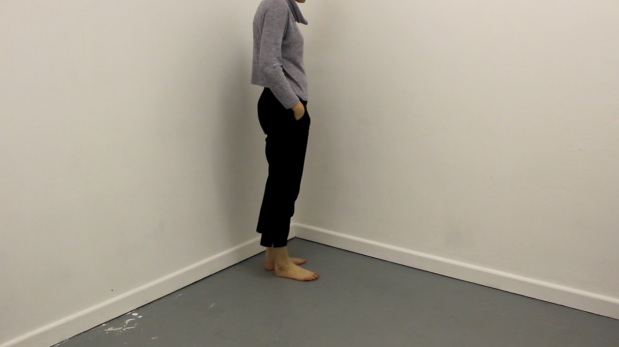
Having been looking at and researching a lot of Performance Art lately I have inevitably been thinking about its modes of documentation. How do we accurately record an ephemeral event in which setting and audience were so crucial? The atmosphere of the room and the reactions of the audience are in a sense part of the artwork; the audience in a sense become co-creators of the work, yet this does not always come across in documentation. It’s incredibly problematic and an obstacle for most people working with performance. There are all forms documentation can take; photographs, film, film stills, text, written accounts, you name it. It’s a matter of finding what works for you and the individual piece of work. In a lot of cases one single image comes to represent a performance piece and this becomes the image that gets circulated. I myself have fallen into doing this with one performance I did (pictured above). This one image is the only one that truly represents the piece, especially given the angle of the room and my feet against the floor in this shot. It’s an exciting moment when you do find the perfect document, but the obstacles it takes to get there are often plentiful!

Performance Art

loving care 1

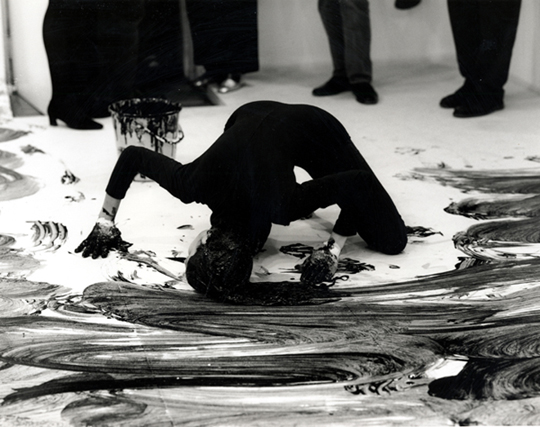
Janine Antoni ‘Loving Care’, image sourced from Artnet.

Having always used and worked with the body as a theme and a medium, it seems only natural that this year I have started to work with Performance Art. This was a movement that came into existence in the 1960s and 70s and is rooted in Conceptual Art. Performance Art is where the artist uses their own body or the body of a model to perform tasks and actions that become the artwork themselves. Famous Performance Artists include Marina Abramovic, Yoko Ono, Yves Klein, Nam June Paik, Bruce Nauman – the list is endless! Pictured above is one of my favourite artists, who has been a huge inspiration since I discovered her two years ago; Janine Antoni performing ‘Loving Care’. This is a work in which she dipped her hair in the hair dye and used her body as a painterly tool. This is in a sense a parody of Jackson Pollock’s painterly techniques and the male-dominated Abstract Expressionist movement, as well as being a social commentary on the domesticity of women. 
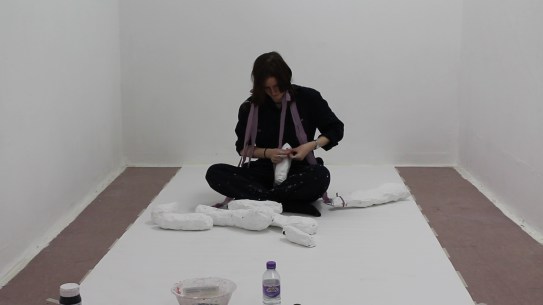
Image6

‘Loving Care’ has been a piece that has stuck with me for a while now and I have always been curious to test this idea of extending the paintbrush beyond itself. I recently cut my hair and therefore thought it would be interesting to do a performance which acted as a reversal to that.  I also wanted to make a gesture towards the impracticality of hair extensions and their artificial qualities. I cut my hair really short, so I wanted to extend it really long. I used the stretchy exercise bands that most people use in the gym, partially because they were a practical object to use in this instance and partially due to the presence of the gym and exercise in my work. 
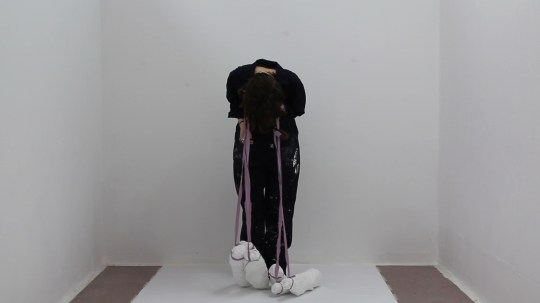
Image13

The white objects I am using are obscure and grotesque limb-like forms that I made out of papier-mâché. This was a very laborious and time-consuming task not only because I made a lot of these objects, but also because of their drying time and formation process. However, the labour was another element to this performance. In it I am not only exploring this idea of body image through the representation of hair extensions, but I am also exploring the repetitive and mundane. Labour is an element not only in the construction of the objects, but also in creating the drawing given how many times I walked up and down the paper.
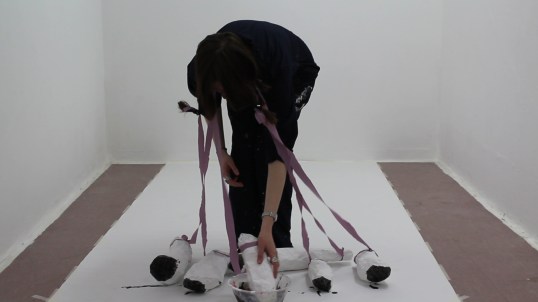
Image14

There was also an element of pain present as although these objects are relatively light, when attached to your hair and roots they are less so! I had a pot of ink and water that I kept dipping these objects into and my intention was to continue until I had used this up, however the pain prevented me from doing so.
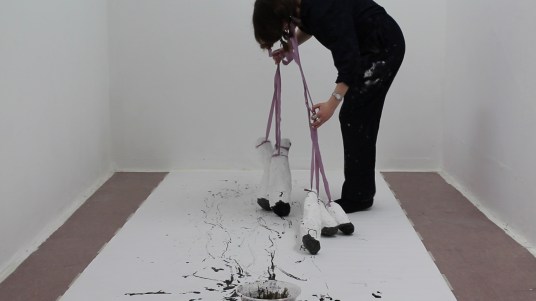
Image19

It was interesting to blend such traditional art materials (cartridge paper and Indian ink) with an act that was so far-removed from conventional painting methods. This mode of working falls into the category of Action Painting, a movement that really took off in the 1960s and is something that I myself have never tried before. There have been moments and elements of it present in my work before, but never in such a direct way. 
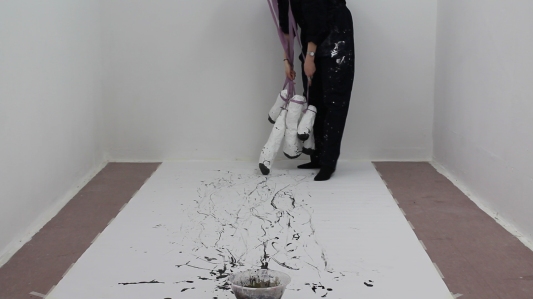
Image20

Given the fact that this art form falls and touches on a lot of aspects of performance itself, costume is consequently a very important part and something I put a lot of consideration into. In some cases I have gone for the stereotypical artsy all-black ensemble, but in this instance I wanted to return to the studio aesthetic which I think tied in well with the rest of the materials I was using.
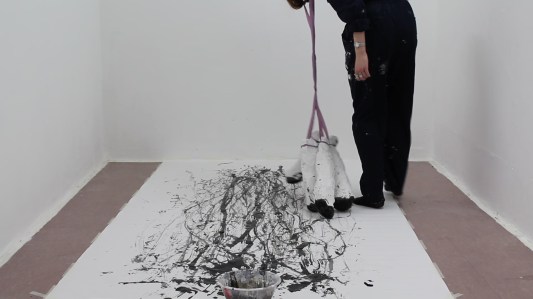
Image22

As well as thinking about what I’ll put on my body for performance work, I also think about what I’ll remove. I am a complete jewellery junkie, always adorned with rings and dangly earrings! I tend to remove all of these elements for the purpose of performance work. However in this instance I kept it all on as I wanted the jewellery to be a part of the work, as an indicator of its constant presence on my body. 
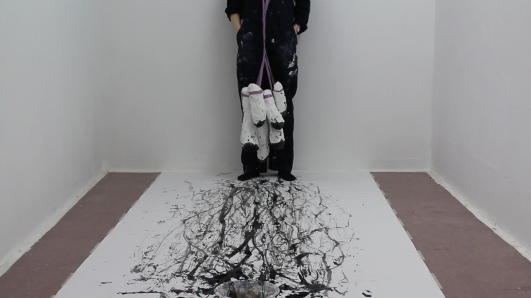
Image23

I think for me one of the most interesting things about working with Performance Art is focusing on and thinking about the objects left behind and how they are imbued both with the trace of human presence and a past kinetic action. What’s exciting is that although the performance is an ephemeral event, the objects left behind hold so much potential for further exploration.
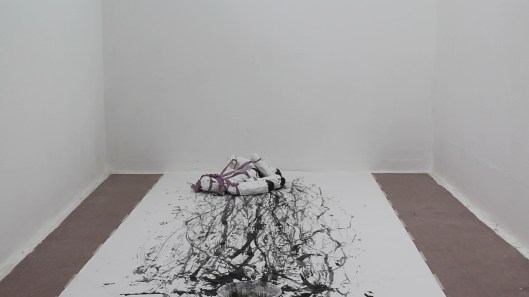
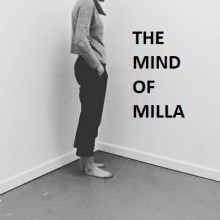
Image27


The Potential for Movement

4W0A8428 (1)

‘The Potential for Movement’, Photograph, 2016

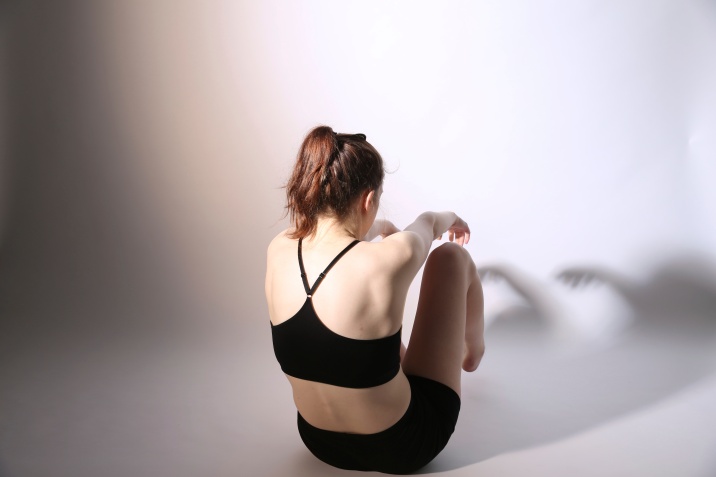
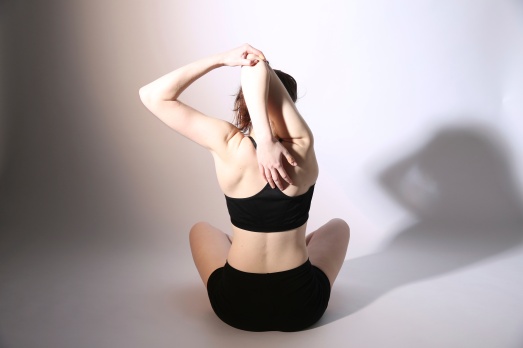
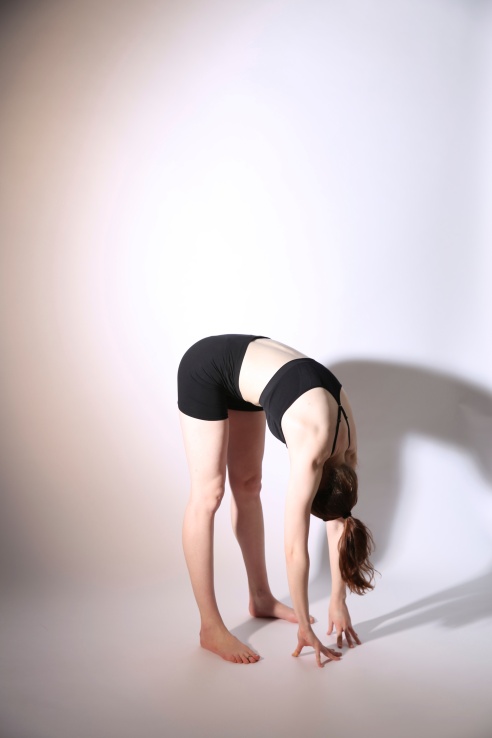
Thinking back to my images taken in the photographic studio the other week, this one in particular stood out to me. It has what I’m calling ‘the potential for movement’. There is so much kinetic energy present here, yet simultaneously none at all. It is completely still; the subject is completely static. Yet in the photograph I am on the brink of moving and creating a fluid action, but at the point the camera captured me the movement had not begun. As a viewer we know an action is about to occur and take place; as no one, despite having fantastic flexibility levels, can hold that position for long! The balance of the body in this image has so much satisfying symmetry to me. This includes the way my hands look as if they are touching my knees, when they are in fact far further forward. It also includes the shadows of my hands along the wall, the balance that my legs are holding, the light dancing across my back. It is peaceful and still but there is also so much potential. It really is a moment captured and frozen in time. 

Happy Accidents

IMG_1683

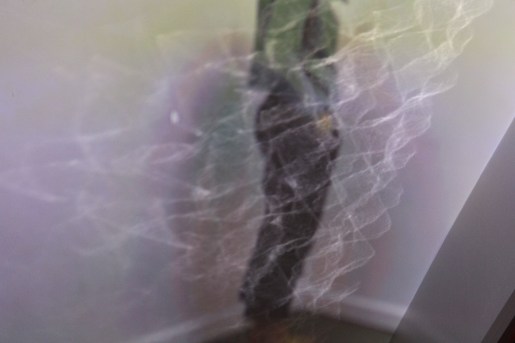
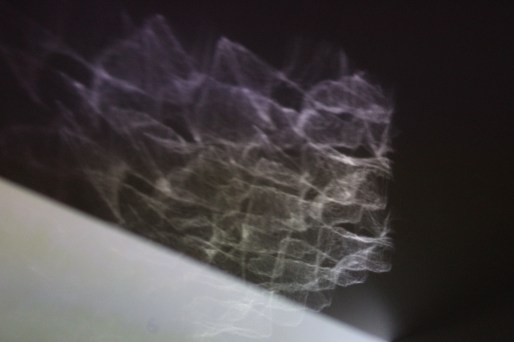
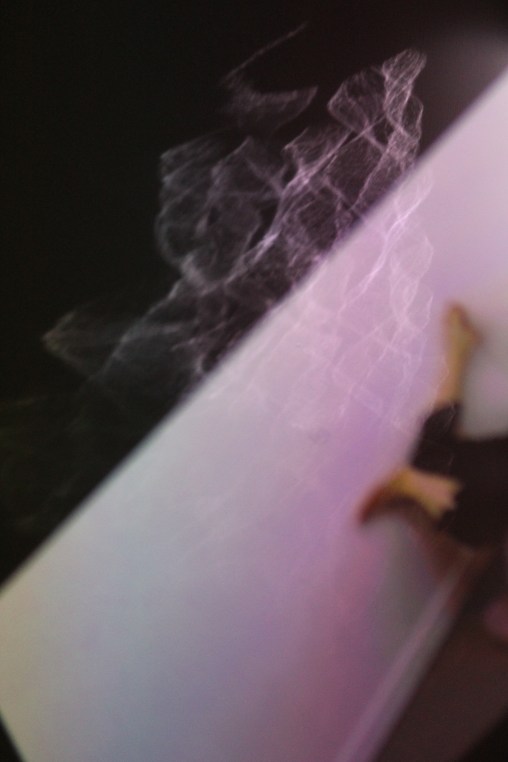
Sometimes we spend so much time thinking and planning as artists and conceptual thinkers, that we forget how useful happy accidents can be. Case in point; these photographs. What started as a simple and very basic projection experiment in my bath room, soon turned into something much more interesting. I had not considered ever using it as an art material, yet my shower curtain came in surprisingly handy. It picked up and diverted the light of the projector to create this rippling and water-like effect across the surface of my images.  

IMG_1684

Although it’s presence is very subtle in some cases, I just feel it adds a certain depth to the image. It creates a collection of layers that bring painterly elements to a photographic setting. Looking at these, I felt again like I was painting; constructing the direction in which the layers would formulate; manipulating the imagery to satisfy my intentions. I could not have been more delighted in this accident occurring. I have a theory that half the genius scientists made their discoveries accidentally and then decided to tell everyone that was what their intention all along! I’d probably do that if I was in their boat and ever discovered anything significant. Although, it’s more likely I would pass it off as intentional because I’d be too embarrassed to admit I’d made a mistake!

IMG_1691

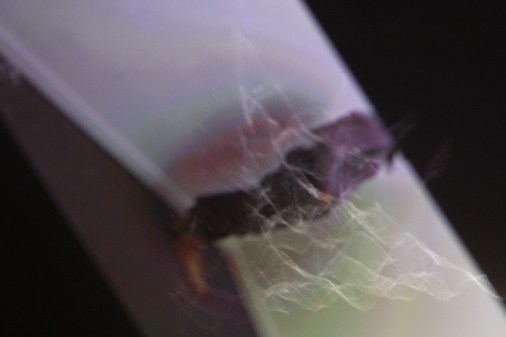
In some cases I was so fixated  and fascinated by  the reflection of the shower curtain, that it took more priority then my actual projected images! Consequently ,abstract images such as the above came into creation. Now there is one happy accident! I think the reason I found it all so mesmerising is because there was so much movement within these ‘reflections’, yet they were entirely static. They are highly evocative of water, yet there is not water present. There is only the suggestion of water and the associations of its sound and movements, all of which enhanced my experience of these images. 

IMG_1687

I wasn’t too bothered about getting the camera in focus either, in fact the lack of focus really worked in this instance. Especially in relation to the colours; the soft pastel hues are not a result of editing, merely a result of the lighting in the space. For me there’s something calming about the way the reflection of the curtain falls across the image. I don’t know if that’s because the images themselves are quite peaceful with their blurry lines and lack of forceful energy. Or if it’s simply because the rippling reflection is so reminiscent of water and all of the connotations that carries. The soothing sound of a river gushing, water’s necessity in the continuity of life, the comfort of a cold, refreshing shower. Or maybe I’m just getting carried away with all my contemplation of water. Then again, it’s such a big part of this whole zen thing that everyone’s got going on that why not join the crowd and start listening to waves and water as I fall asleep!

Muscular Awareness Part 1

4W0A8420 (1)

The other day my friend kindly gave me a hand in the photography studios to help me capture these images. If you have been reading my posts you will know by now that my artwork revolves around the human body. If you have never read a post this could not be more perfect an intro! More often than not my practice is about the implicit body; it relies on subtle hinting and allusions to the human form. So for once I wanted to deviate from that quite strongly and create a really direct link to the body.

4W0A8254 (1)

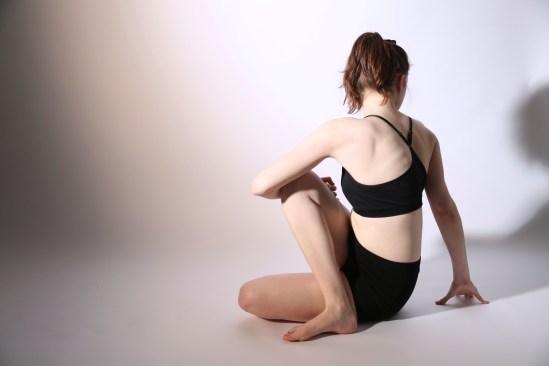
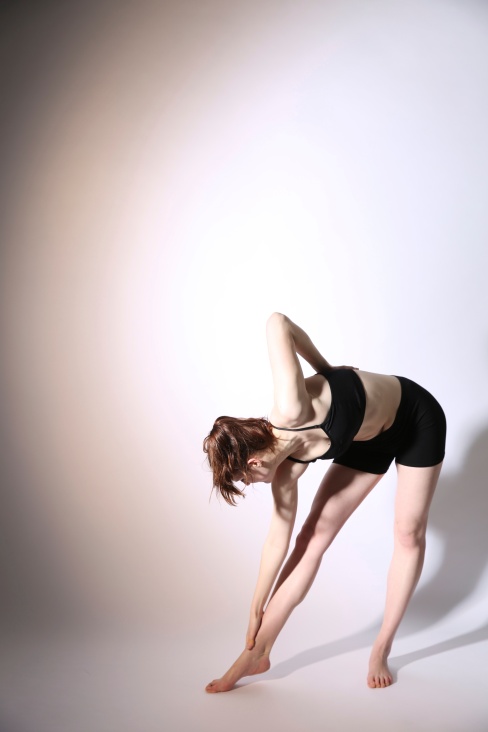
As a result, these images came into existence. I have been gyming for about five years now and I absolutely love it. It is my zone, my head space. For an hour I leave the outside world behind and focus purely on the relationship between mind and body. I focus on the pain I feel, the endurance I push myself through, the tiredness and aches when I finish an exercise. I think of gyming as a discipline and it’s one I keep up as often as I can. People often underestimate the importance of stretching and often do this hurriedly and hastily. That is not the case for me. Stretching is one of the most important components of my work outs, which is probably a result of my love for yoga. So I spend a lot of time on the mats, which more often than not are in front of a mirror. 

4W0A8243 (1)

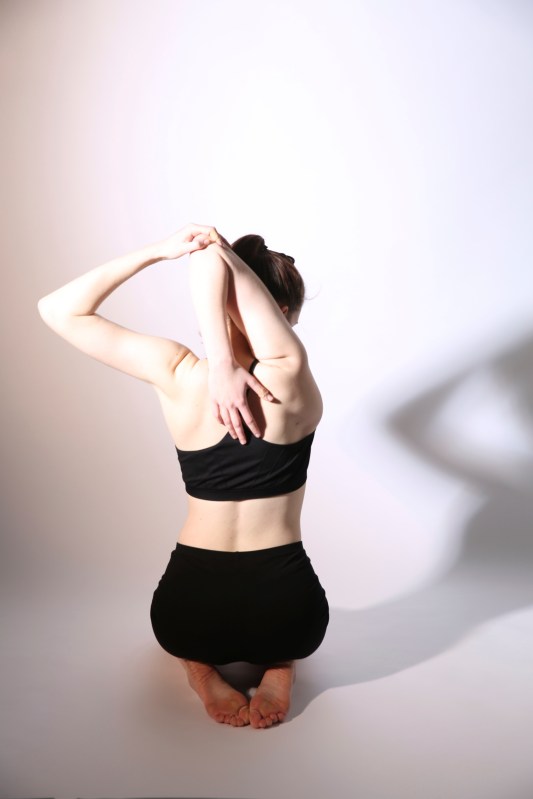
Yes, the instant connotations of a mirror mean vanity, but for me that is not the case. All of these years stretching in front of a mirror has made me notice little dents and muscles in my body that normally no one pays attention to. Because I’m stretching myself into bizarre and unusual positions, the less prominent muscles start to emerge, which I have always found incredibly fascinating. Most interesting to me are the dents and muscles surrounding my shoulder blades; there is a surprising amount of detail in this area. Up until now I have merely observed these muscular formations. Every time I see them in the gym I think about how great it would be to study them more closely. To draw them in pencil and charcoal and exaggerate them Michelangelo style. Of course, I’m not going to bring a photographer into the gym with me to document them! Not only would that draw a lot of unwanted attention but I would also probably have to fill out a whole bunch of Risk Assessments and Ethics Forms. No thanks!

4W0A8232 (1) 

So instead I thought I’d bring myself and my stretches into the studio; really highlight all these muscles through dramatic lighting. This was quite an adventurous experiment for me as it was a very explicit display of my relationship to the gym (it was also an hour of nonstop stretching for the camera – what a work out!) Yet it could not have come at a better time. Recently in uni I have been having tutorials that critique and discuss my work. They have taken a surprising turn for me as the feedback I have received is to further my exploration of the gym and this notion of head space. How funny that I thought these images were too explicit in their reference to the gym, yet that is what the tutors want to see more of? It’s my lucky day! 

4W0A8304 (1)

I quite like how the images I have posted here are essentially faceless; there’s a sense of ambiguity to them as a result. The lack of face also heightens the focus on the body. This is further highlighted by the stark black clothing (or lack of it!) against the whitened backdrop. Some incredible shadows have emerged too – perhaps I need to do some sketching of merely the shadowed areas. With this high contrast lighting, I finally get to emphasise all the little folds and creases that I have spent so long studying all this time in the gym. Artists talk about spending a certain amount of time with an artwork and sitting on it. If you think about it, I’ve been contemplating this specific work for years! So not only is it exciting to see it come to life as an artform, but it’s also a relief to finally realise and create it!

Current Work; thinking site-specifically

2

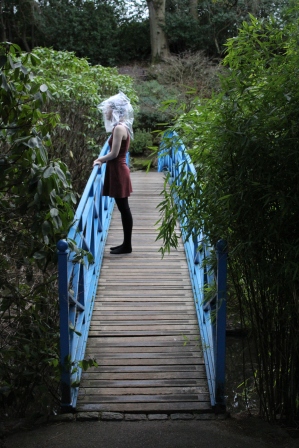
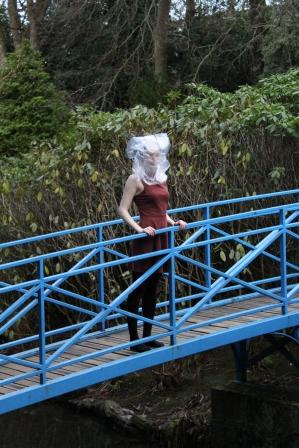
I haven’t posted about my work in a while and seeing as I’ve been doing lots of it recently, I have a lot to talk about. Starting with this shoot. As I’ve slowly begun to enter the realm of performance art I have had to become increasingly aware of location in relation to my body. Where I place myself is just as important as the actions I carry out in the space. So I’ve been looking into site-specific art and reading various takes on the notion of the ‘white cube’ gallery space; how does placing your work within four white walls limit it? Does this impose an unwanted constrain? It depends on the work of course, some pieces thrive in a gallery setting, others need to expand beyond that. So this is what I’m playing with here. 

1.jpg

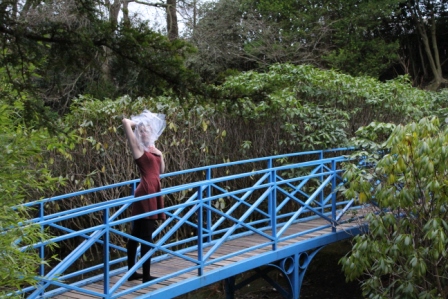
It was an instinctive decision to take my work to a natural based environment in place of the studio. Taking it to other buildings and artificial places such as shopping malls or car parks bring in too many connotations of capitalism and commercialism. Not my intentions by any means. Nature on the other hand sits well alongside my focus on the human body. So when I was back home I took myself to the gardens near my house and played around with the ideas of the artificial within nature and the obscurity of self. 

3.jpg

I’d actually forgotten that the bridge was painted blue and was really struck by how it stuck out in among the otherwise natural landscape. It was actually the bridge my parents had their wedding photos taken on so as well as complimenting the intentions of my shoot, it also holds a historical attachment for me. This brings in the element of time which I have  been looking at a lot recently, particularly in terms of viewing it as a medium and artistic concept in itself. There are several layers to my exploration of time in my current work which I won’t go into in depth, but a very simple aspect of it in the case of these photos is simply my choice of clothing; it’s very much a 1960s style dress which reverts back to a past era.

4

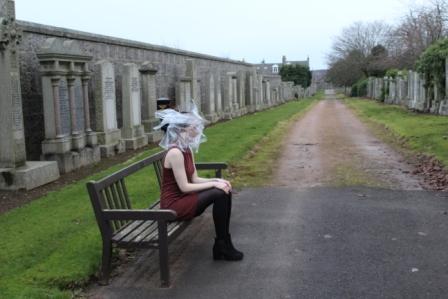
Time also comes into play when we photographed in the graveyard. There are a lot of things present in this, most obviously is the sensitivity of photographing in such a sacred place. Respect is something therefore that plays a big part in this as I was not wanting to be disrespectful in any way. Instead, I wanted to bring out the beauty in a place that is more often associated with grief and pain. Given the conventional associations of a graveyard, it was quite difficult to avoid what felt like an eerie scene. Unlike the gardens which were bursting with life; where there were children playing on the swings, ducks swimming in the pond, water flowing, etc. There were also a lot of people wondering the gardens as we were shooting.

5

In contrast to the gardens, the graveyard was empty; completely devoid of life. This felt very poignant as the two settings both reflect what it is they represent. The graveyard was quiet with nobody present, apart from the deceased. Whereas the park was full of youth and water. Water of course is the key to life and represents vitality. It is also another thing alongside time that I have been studying. So although from the outset the shoot kind of looks like I plonked myself in two settings for effect, that is not the case. They are highly considered. Nothing in my work lacks purpose, because otherwise I do not see the point in creating it. By formulating something with meaning, it allows the work to be more emotive and therefore better received. Or at least I hope so as emotive art to me is the most touching and consequently, the most effective.