Panic Attack Series

026

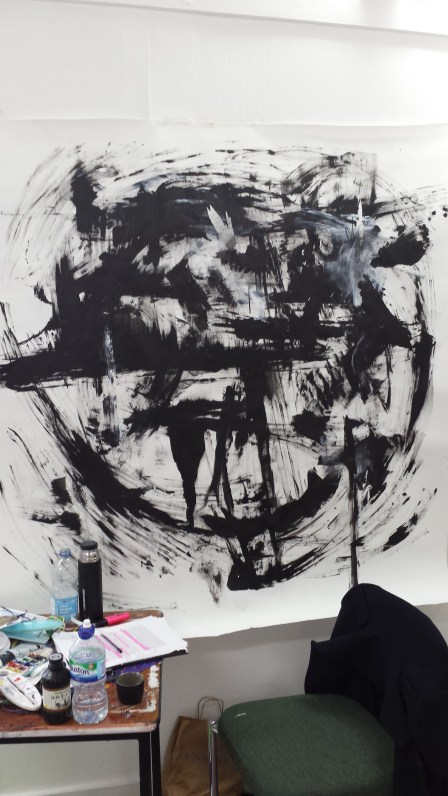
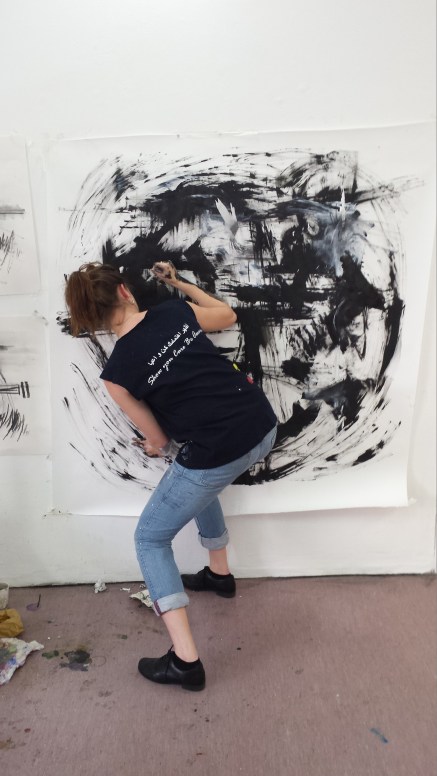
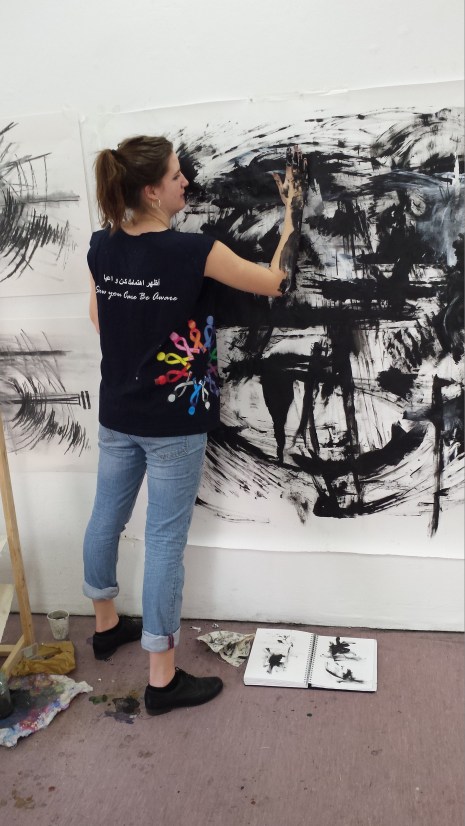
Being a creative person is the best thing in times of trauma, sadness and general unhappiness. Being creative provides you with an outlet that may not otherwise exist; a space to release all the inner burdens. I had a series of panic attacks last year as a result of some emotional baggage and initially they were out of control and horrific. They are very physical events that consume your entire body. I’d never experienced anything like them before so it was something entirely new and very unpleasant. However, as usual art came to my rescue and I found refuge in it as an expressive tool. Having experienced the physicality of the panic attacks, it seemed natural to translate this kinetic experience into the art-making process. Consequently I created a series of works, what I call my ‘Panic Attack Series’. 
015

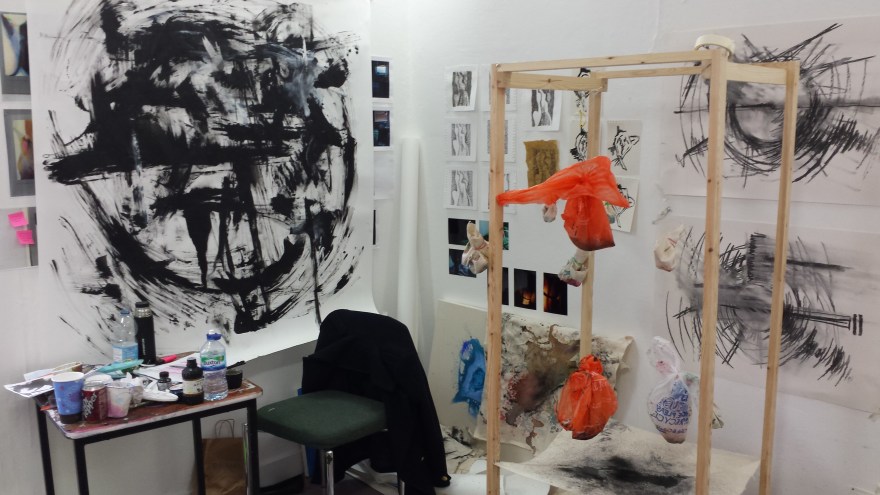
Given the process it took in creating them, they could be considered Action Paintings. Action Painting first came into being in the late 1940s and early 50s with pioneering artists such as Jackson Pollock and Willem de Kooning leading the way. Action Painting is a loose and fluid mode of art making in which the paint is dripped or smeared onto the canvas. In this instance I was smearing it on, using my forearm as a brush which given the friction between the paint and paper was painful at times. Yet this pain became part of the piece. Working large scale was necessary as I required the breathing space to expel my negative energy. The works are far from perfect, but I think my vitality comes across especially given the unconscious circular motions I ended up working in. I was surprised to find I visualised my panic attacks as circles and this meant that they went from being a nightmarish experience to a visual object which I think aided my healing process. I was not surprised by the fact black felt like the only suitable colour; darkness and the heaviness of my emotions was encapsulated perfectly in this palette. 
027

I also did some smaller charcoal renditions which looked almost like circular sound waves (top right of the above photo). I think the need to get messy was an instinctive impulse I had in these expressive works. Sitting tidily working in a sketchbook would not have had the same impact. I needed to immerse myself physically as well as mentally in the work to be truly unburdened. 
021

And it definitely worked. The creation of these pieces was incredibly liberating and I literally felt like a weight had been lifted. My shoulders felt lighter and my head felt clearer. It was as if by creating these works I had expelled this mass of black energy from my system and I was free to start again. 
Sensual Materials

IMG_9554

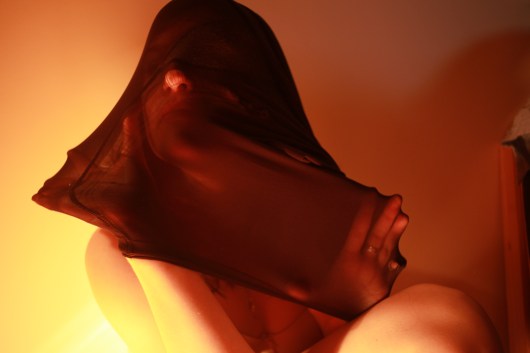
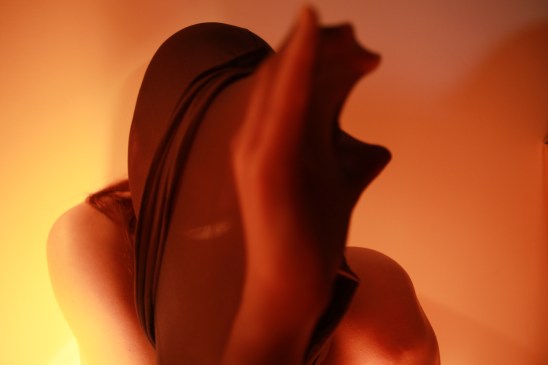
I have this absolute nightmare of my tights ALWAYS getting holes in them. It drives me nuts; my toes peep out, the ladders run up the back of my leg, I don’t think I own a single perfect pair of tights! So being an artsy creative person I of course think of new ways to use them when they’re on their way out, otherwise there are far too many tights going to waste!  When I did these shots, I’d recently been using cling film to cover and wrap my body in. So these photographs were kind of an extension of that experiment. Of course, wrapping your body in cling film holds very different connotations from interacting with fragile tights. 

IMG_9552

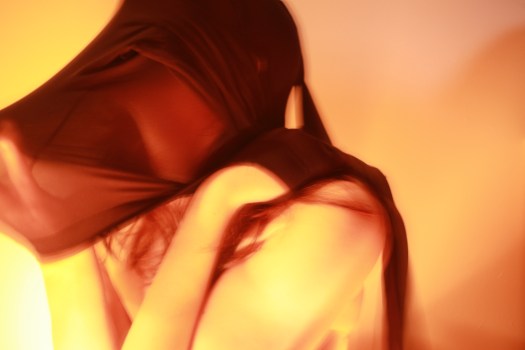
I was quite pleased with how these photographs turned out. They are completely unedited, I just used a desk lamp directed at a very certain angle to get these colour shades. Normally putting something over your head is claustrophobic and uncomfortable, but given the transparency and delicacy of the tights there were no problems at all. It was more exciting trying to develop a relationship with the material and mould it into interesting shapes that worked both within the frame of the photograph and in relation to my body. I had a tripod set up to take these, so it was all very trial and error; I only got three good photographs out of all the ones I took. That happens most of the time with photography though and the shapes I did manage to create here complemented the warm hues of the lighting. 

IMG_9546

Despite the lack of editing, the colours came out really well; they shift between pale pastel yellows and orange-tinted pinks. I was also really happy with the blend of focuses; the fixed outline of certain areas such as the head in the photo above, against softer and more ambiguous outlines as in the case of my fingers in the above. Out of all components of my torso, I think my hands looked the most interesting encased in the tights, as the fingers are usually so mobile and free to use that is was strange to see them restricted. Yet the conflict present within the restriction is interesting as the hands are encased by the most fragile material and have the ability to break free at any moment. This potential is most evident in the middle picture where my fingers are most pronounced. I also think this potential is evident in the blend of static and movement. Although I am holding still and posing for the camera, there is so much movement in the light and the material which provides an interesting contrast to the overall result. I think these aspects are why these photographs are successful to me; I’ve taken a simple everyday material and tried to adapt it into something entirely new. 

Sculptural History

P1160755

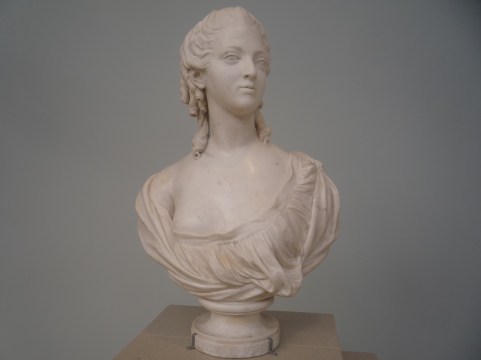
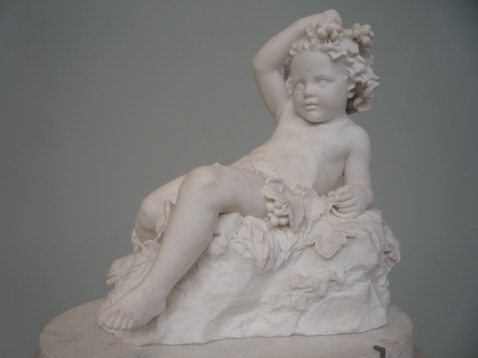
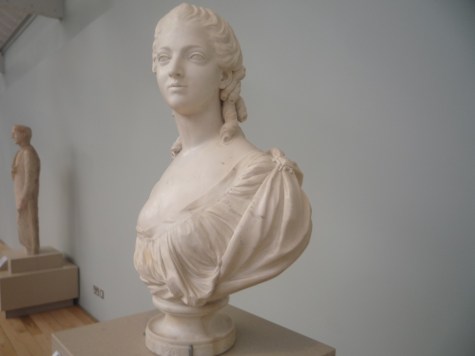
Surrounding myself with so much contemporary art can sometimes be exhausting; there’s so much technology to take into consideration with this genre, so many modes of display and notions of space that you have to consider in the reading of it. For me it’s really refreshing to take a step back from it all and immerse myself in more traditional art forms. These photographs were taken at The National Museum of Scotland in Edinburgh. I’ve always found the history of sculpture fascinating, I think mostly because I am in total awe of the skill and craftmanship which would be required in the making of marble sculptures such as these. 

P1160760

What I’m intrigued by is how our use of sculpture has evolved over time. Traditionally in places such as Ancient Egypt it was used as a representation of Gods and deities. Sculpture is a fundamental component to certain cultures and religions. Places such as Hindu temples are embellished with religious motifs and decor. The stone, bronze, and iron materials all come to take on the form of a god-like being that cannot be made physical through any other manner. Ancient Greece is renowned for its captivating monolithic sculptures; pieces that were carved out of a single block of stone in depiction of all their Gods. These days sculpture is used very differently, more often than not it is used as a means of forcing us into an awareness of self through our relationship to a sculpture in a certain space.  This way of working has for me become so commonplace, that I have almost lost interest. I want to go back and look at the traditions of sculpture; it’s rich history. 

P1160757

My love and interest in history as a subject of course feeds this intention of mine. I studied history all through school and had it on the cards to study at university level. Art of course got the upper hand in my final choice of study, but my love of history remains and I currently do weekly volunteer work as an archive researcher which is something I absolutely love. So for me sculpture is very much imbued with history, neither can be separated from the other; both entirely and intrinsically linked. The history of sculpture is also mostly concerned with the human form, again a predominant interest of mine. Both my human body and historical interests is why I am more drawn to the ‘modern’ sculptural works of Henry Moore and Barbara Hepworth as opposed to something like Tracey Emin’s bed piece. Despite Emin’s conceptual reasoning for this piece, to me it is in all honestly entirely mundane. Traditional sculpture on the other hand, such as the work pictured here, is truly mesmerising to me. How long did these take to construct? What kind of tools were used? How many people worked on them? What were they created for? How old are they? All of these questions and possibilities run through my head when I look at traditional pieces such as these and regard them in relation to their historical presence and significance. 

P1160761

Bodily Structures

6A7A9528

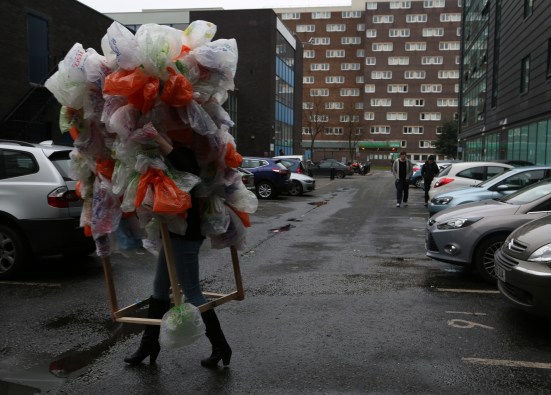
Sometimes you can look like an absolute weirdo in your art making. I think this moment was one of those instances. It looks a lot stranger than it was, but the moment in which I placed myself in among this structure and walked about a section of uni campus did allow for feelings of self-consciousness. It was interesting however to place myself within a structure I had been working with for so long. The structure is a sculptural representation of the human body; the wooden components symbolise the bones and support structures that hold our bodies upright and the bags represent the lungs and air pockets that keep us breathing. In some of my experiments I hung little bundles that dripped onto the floor with ink, as a representation of both small organs and our bodily fluids. To have worked with this sculpture as a representation of the body for so long, I had developed a relationship with both the structure and the materials. So as well as creating some interesting images and getting some strange looks doing this, it was great to physically immerse myself in the piece. 

Studio Fun

IMG_1531

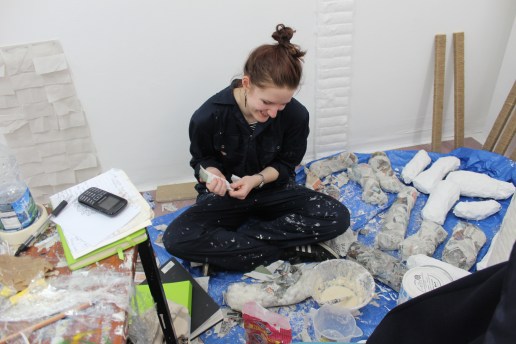
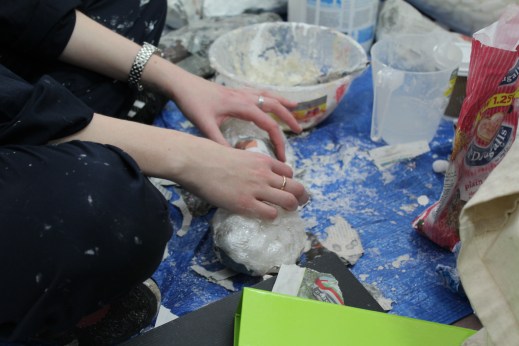
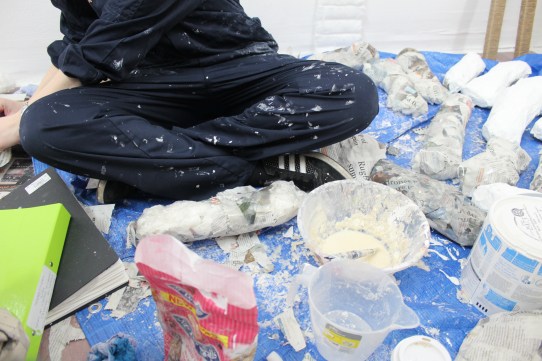
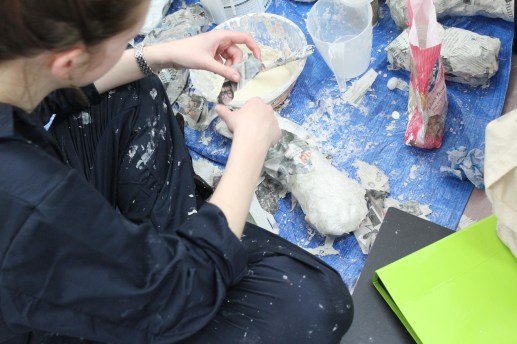
Sometimes it’s really refreshing to step away from all the thinking and the books and just work with a material. I had these foam polystyrene pieces (the kind you put in packing boxes) that I decided to paper-mache into limb-like forms. I didn’t really have a plan or know what I was doing, I just wanted to get my hands dirty. I had to wrap them up in cling film first to create a more solid framework for the paper-mache to sit on and this was a very fiddly and frustrating process. 

IMG_1528

Despite this, it was great to be back in a boiler suit and sat in my studio making mess. So much of my work this year has been film, photography or performance documentation; essentially all digitally based, so it was a relief to make some physical objects and hold these items in my hands. I’ve enjoyed working in this way this year as Performance Art has been the direction my work has naturally taken. I never planned to go down the route of performance, but my will to push personal boundaries and explore the human body in ways I haven’t before has resulted in me drifting into the realm of performance.  

IMG_1534

These limb-like objects eventually ended up being used in a performance piece. Initially this was not the plan, I had no idea where or what these would become. These days I always tend to have a rough notion of where an idea is going to go or how it will work out. It’s never perfect of course but having a rough outline gives me something to work towards. So in this case it was strange just making with no outcome in mind, yet it was also quite liberating. 

IMG_1529

This liberation eventually turned into frustration however. These objects were so time consuming to make, especially with the drying time factored in, that I eventually lost interest. I think this was mostly due to the fact I had no direction and no idea to follow, so the objects became dormant. They ended up sat clustered in my studio for ages and eventually I started to develop a kind of resentful relationship towards them. Recently I had the impulse to use them as I couldn’t handle the idea of all those hours of labour going to waste. So I decided to incooperate them into a drawing-based performance. I was really glad it worked out this way, as it was interesting to go through such a journey with these objects. At first I was excited to create them, then the making process evolved from being therapeutic to a chore and finally I got fed up and found them to be useless. This period of uselessness lasted for ages, so it was incredibly satisfying to draw them back into another piece and find them to finally be useful and exciting again. 

Take a look at my Performance Art post to see how I eventually used the objects: www.themindofmilla.com

Acrylic Work


eye
Eye Study (Warm Hues)

It’s fascinating looking back at old work and seeing how my style has evolved and changed over time. What intrigues me most is not simply my evolution in technique, but my interest and use of material. I have experimented a lot over the years and have come to find that you can never fail with fine liner pen! You could argue it’s a very simple material; everyone owns a black pen, yet I have come to find it is also the most effective in a lot of cases. For me the addition of fine liner is often the perfect finishing touch to a painting. My love for pen has remained constant over the years, yet my feelings for other materials have changed drastically. When I was younger I found watercolours difficult to use and frustrating to control, yet these days most of my paintings are water and ink based; I can’t seem to get enough of the fluidity!

eye2
Eye Study (Cold Hues)

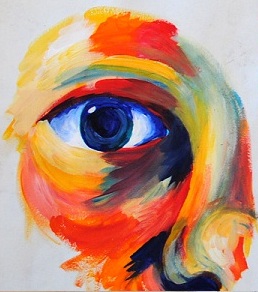
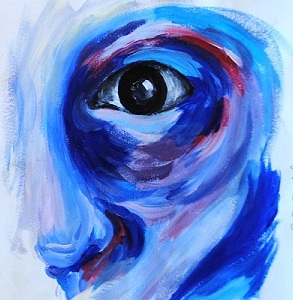
I went through a phase where acrylic paint was my favourite medium (this was before I discovered oil paint!) mainly due to the layering it allowed. When I paint I build my work up slowly by gradually applying multiple layers, as you can see in these colourful eye studies. Acrylic was perfect for working in this way as it meant a short drying time which was perfect for my instantaneous manner of working. It’s also a very affordable material, especially when compared to oil paint which is depressingly expensive most of the time. I came across these old painterly experiments when I was looking through things I’d submitted as part of my university and scholarship portfolios. They’re about four or five years old now and I haven’t used acrylic paint much since then. Having looked back over them, I’m tempted to give acrylic paint another go given how much my skills have changed over time.

Body Poses

4W0A8418 (1)

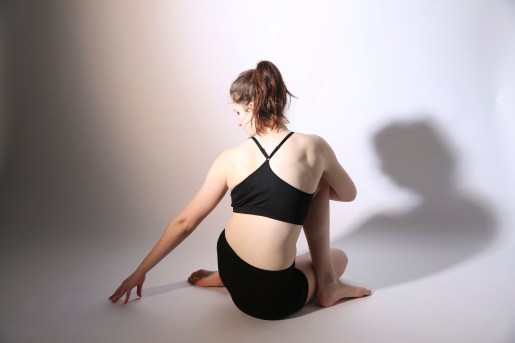
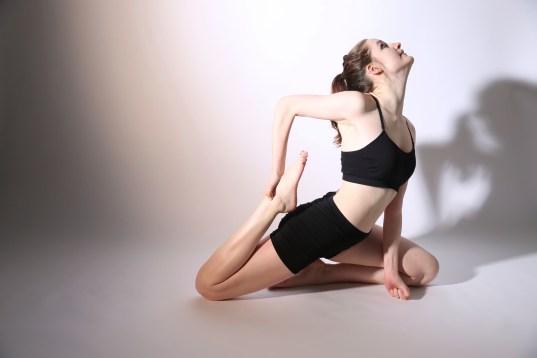
It’s amazing when you stop and think about the body; when you register the fact all of your movements are controlled by tiny little messages sent along your nerves and synapses, allowing you to move instinctively without thinking. Transmitting instructions that allow your body to function. These days we are so preoccupied with image, diet, building artificial muscle, losing weight, gaining weight that we forget to think about our core components; the things that actually matter. How our muscles stretch as we bend our arms, how the skin moves with your joints, how our bones click and slot into place as we sit down, how we blink to keep the dust out, how we breathe as our pulse rate changes. All of these small little details are so crucial to everyday life, yet how often do we stop and think about them? How often do we take it all for granted? How often do we truly contemplate the wonders that are our bodies? 

4W0A8278 (1)

I have very bad knees, so I am constantly aware of the clicks and the shoots of pain. Yet in a weird way I am grateful to this pain. It forces me to slow down to reduce impact on the kneecap, or stop shin splints. Often I can feel my knee caps clicking and sliding over each other like a machine. I am so aware of these faults in my body that I can’t help become aware of everything else. This is why I love the gym so much, as I enter that space it allows me to open up a direct dialogue with my body. In the gym my actions are entirely dictated by the balance of mind and body; how far can I push certain muscles? How long can I do certain weights? How long should I spend stretching? It is almost as if I go deeper into myself in these moments as the mind dissolves and becomes one with the body. 

4W0A8328 (1)

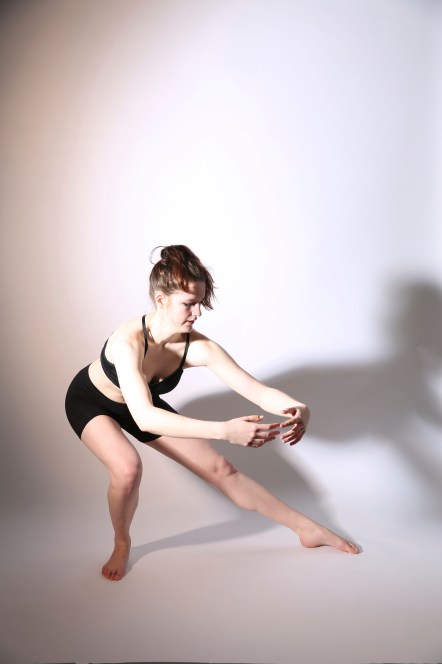
Balance and endurance are core components of my workouts. There’s the will to stop verses the will to continue. As well as being good for fitness and strength, I believe the gym is also very good for the mind. Going on a regular basis takes commitment; continuing on a machine for a certain amount of time takes willpower. It is all a discipline in which the mind and body are intrinsically wrapped up in each other. I often find it difficult to get this across to people, as everyone has their own reasons for gyming, or some people I know don’t gym at all. Investigating my feelings further in my artwork is helping me to better articulate myself. I feel these images and their poses are highly effective in highlighting a lot of how I feel about exercise and its necessity for me in daily life. 

The Power of Image

15

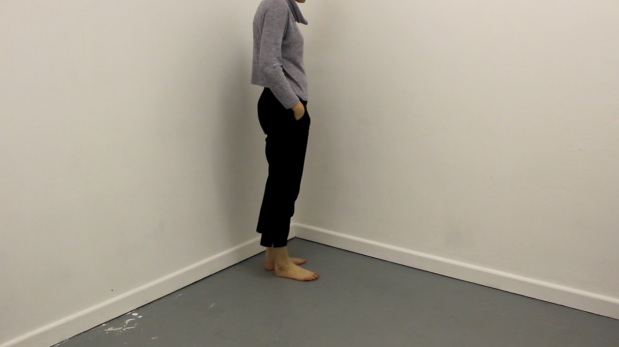
Having been looking at and researching a lot of Performance Art lately I have inevitably been thinking about its modes of documentation. How do we accurately record an ephemeral event in which setting and audience were so crucial? The atmosphere of the room and the reactions of the audience are in a sense part of the artwork; the audience in a sense become co-creators of the work, yet this does not always come across in documentation. It’s incredibly problematic and an obstacle for most people working with performance. There are all forms documentation can take; photographs, film, film stills, text, written accounts, you name it. It’s a matter of finding what works for you and the individual piece of work. In a lot of cases one single image comes to represent a performance piece and this becomes the image that gets circulated. I myself have fallen into doing this with one performance I did (pictured above). This one image is the only one that truly represents the piece, especially given the angle of the room and my feet against the floor in this shot. It’s an exciting moment when you do find the perfect document, but the obstacles it takes to get there are often plentiful!

John Virtue

P1180052

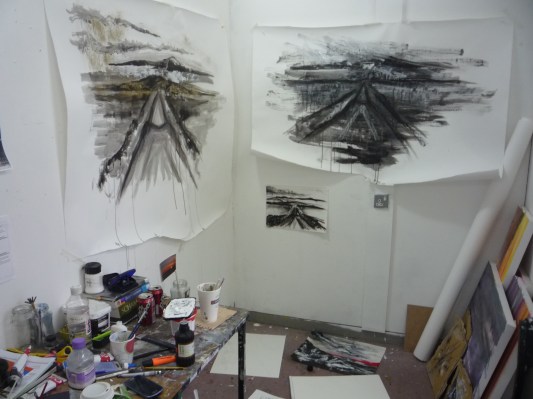
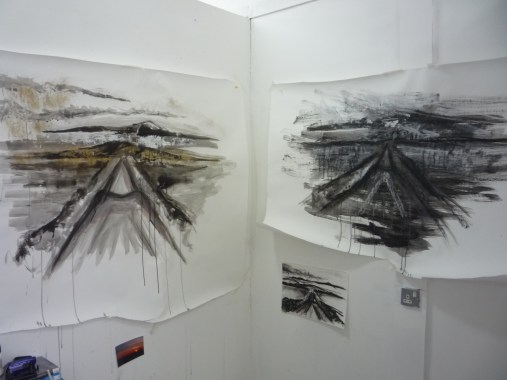
I was looking through some old work when I came across these images of my First Year studio. This was probably the one and only time my choice of topic deviated from Body Art and instead focused on the natural landscape. I think I surprised even myself in this shift as there was no real explanation for it apart from my discovery of oil paint. I think I felt that abstract landscapes were a better means of exploring this medium, as opposed to again working with the female body which I was already so familiar with. This shift was also due to the fact I discovered the work of John Virtue (see below).

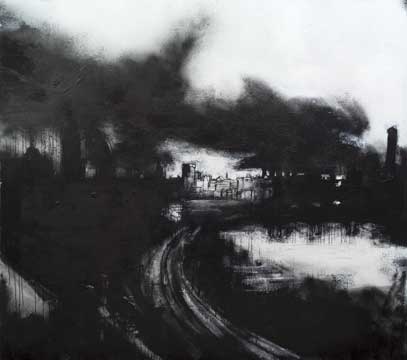
 john virtue

‘Landscape No. 707’, 2003-4, image sourced from The National Gallery website.

I fell in love with his whimsical monochrome depictions; how they were abstract yet figurative simultaneously. How he combined nature with industry. The blend of such intense darkness against the stark white also lends a satisfying balance to his work I found. This equilibrium allows the eye to shift peacefully across the page, taking the time to absorb intricate aspects such as texture which are so imbued with the studio aesthetic.

P1180042

What I found particularly interesting about Virtue’s work was his ritualistic aspect of his art making. Every day without fail he would walk to the same location to sketch. This of course resulted in an excess of drawings, but the dedication this required fascinated me. So for a while I chose to copy this method of working and walked to a park everyday. It was quite out of my way and in some cases an inconvenience to all of the other daily necessities occuring in my life. However, having this task and this escape also gave me the best kind of zehn I could have wished for. I had an excuse to leave behind the rush and pace of daily life to focus fully on ritual-based art making. 

P1180051

I also tried to employ Virtue’s use of the monochrome palette by removing colour from my work. Depicting landscapes and working with oil paint was a time where I was using really vibrant and sunset-based hues, so this removal was a real challenge for me. It forced me to think a lot more critically about texture, shape, scale and all of the other elements that could compensate for lack of colour. I poked needle-thin holes through paper, I worked with impasto and modelling paste, I used charcoal and inks to create that messy studio look. I tried everything and had great fun experimenting, but of course I gradually began bringing colour back into my work. I also sadly had to stop my daily excursions to the park given all my other commitments, but I may some day start that again for a brief period at least. Employing the working methods of another artist was a really interesting and liberating experience for me, as I was giving up all sense of control that I had over my work and instead completely yielding myself to working in a certain way. It was an incredibly enjoyable experiment and is something I think I’ll definitely go back to at some point!

Critical Writing for Vane Gallery

Recently I have been trying really hard to work on and expand my writing skills; as much as I love blogging and using colloquial language, I also enjoy writing in more formal and critical terms. Recently therefore I submitted two pieces of critical writing Vane Gallery and I am delighted to have found that they have both been published. Feel free to have a read on the links below:

IMG_8250

‘The Beauty in Grotesque’, a critical review of Jock Mooney’s exhibition ‘Who Are You and What Do You Want?’ at Vane Gallery. Click here to read. 

IMG_8256

‘Layers of Meaning’, a critical review of Oliver Braid’s exhibition ‘The Nude Ignity’ at Vane Gallery. Click here to read.